

Lexicon of Lost Knowledge
I Ching

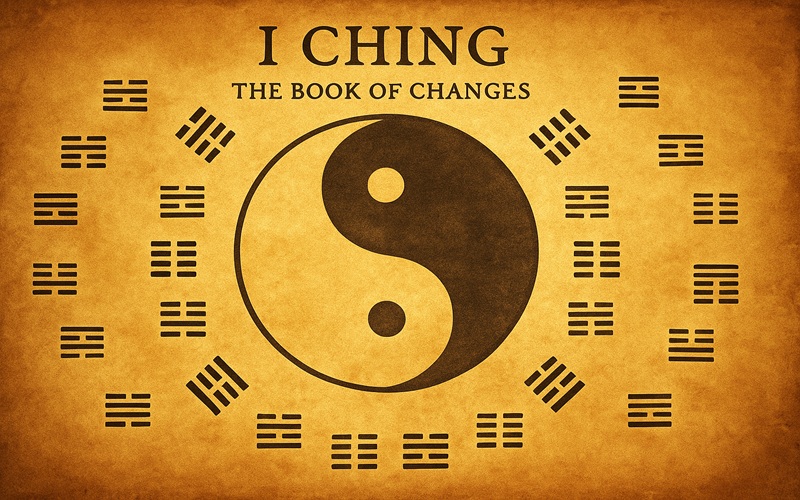
Definition:
The I Ching, or Book of Changes, is one of the oldest Chinese classics—an oracular text that encodes the principles of transformation through sixty-four hexagrams composed of yin and yang lines. Each hexagram symbolizes a dynamic state of change in the universe, revealing how energy evolves between harmony and imbalance. Used both for divination and philosophy, the I Ching expresses the interplay of Heaven, Earth, and Humanity as a continuous cycle of adaptation and wisdom.
Deeper Meaning:
Beyond fortune-telling, the I Ching is a map of consciousness and a manual of universal law. It teaches that reality is not static but constantly shifting between polarities—light and dark, stillness and movement, receptivity and initiative. In Hermetic and Taoist traditions alike, the I Ching is viewed as a living code of synchronicity, where each reading becomes a dialogue between the cosmos and the mind of the seeker. The hexagrams are symbolic mirrors of inner states, showing how personal intent aligns—or conflicts—with the rhythm of the Dao. Through meditation on these patterns, one learns to act at the right time, harmonizing free will with destiny. Its structure resonates with Western mystical systems like the Kabbalistic Tree of Life and astrological cycles, suggesting a shared architecture of sacred order across civilizations.
References in Texts:
The I Ching influenced Carl Jung’s work on synchronicity, Leibniz’s discovery of binary code, and remains central to Taoist and Confucian commentaries such as those of King Wen and the Duke of Zhou. Modern esoteric scholars see it as a symbolic bridge between Eastern divination and Western alchemy of consciousness.
Related Concepts:
- Tao
- Yin and Yang
- Synchronicity
- Hexagram
- Kabbalah
- Tarot