

Lexicon of Lost Knowledge
Horoscope

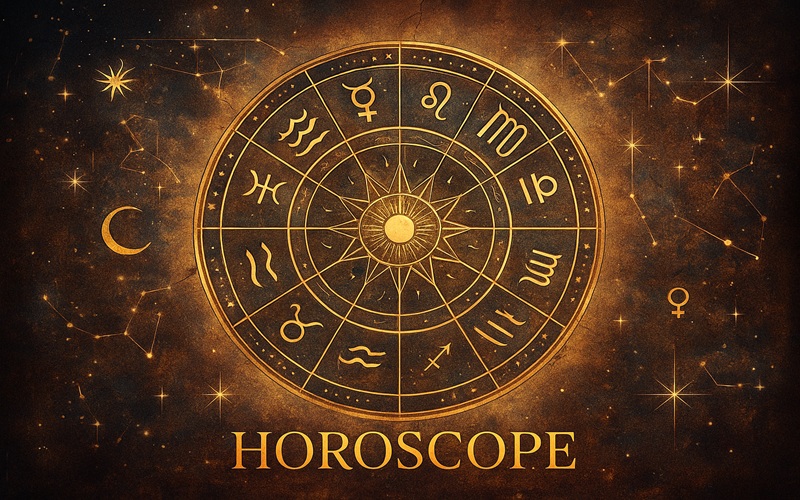
Definition:
A horoscope is a symbolic chart that maps the positions of the Sun, Moon, and planets at the moment of one’s birth—or at any given time—to interpret destiny, temperament, and cycles of change. Derived from the Greek hōroskopos (“hour watcher”), it reflects how celestial patterns imprint themselves upon earthly life. In astrology, the horoscope is both a mirror of the heavens and a blueprint of the soul, revealing the dynamic relationship between cosmic order and human experience.
Deeper Meaning:
Beyond personality readings and daily predictions, the horoscope is a sacred diagram of consciousness in time. It represents the alignment between the macrocosm (the universe) and the microcosm (the individual). Every planet signifies an archetypal force—the Sun as the core Self, the Moon as the emotional rhythm, Mercury as thought, Venus as attraction, Mars as will, Jupiter as growth, Saturn as discipline, and so forth.
In esoteric astrology, the horoscope becomes a mandala of initiation, showing the stages of soul evolution across lifetimes. The twelve houses correspond to the realms of existence—from self-awareness to transcendence—while the aspects between planets reveal the interplay of fate and free will. The adept does not see the chart as fixed destiny but as a living symphony of energies that can be harmonized through consciousness. Thus, the horoscope is both a map and a mirror—a sacred instrument for self-discovery, prophecy, and alignment with the divine rhythm of the cosmos.
References in Texts:
Ancient astrologers like Ptolemy, Dorotheus of Sidon, and Vettius Valens used horoscopes as tools of divination and healing. In later Hermetic and Renaissance traditions, it merged with Kabbalistic and alchemical symbolism, influencing mystics such as John Dee and Cornelius Agrippa.
Related Concepts:
- Astrology
- Natal Chart
- Zodiac
- Fate and Free Will
- Aspects and Houses
- Cosmic Correspondence