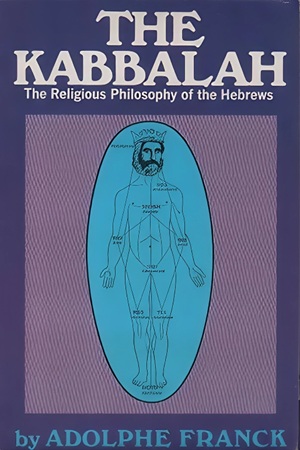
The Kabbalah: The Religious Philosophy of the Hebrews
25.19 $
| Author(s) |
Adolphe Franck |
|---|---|
| Product Type |
Ebook |
| Format |
|
| Skill Level |
Intermediate to Advanced |
| Pages |
277 |
| Publication Year |
1926 |
| Delivery |
Instant Download |
The Kabbalah: The Religious Philosophy of the Hebrews by Adolphe Franck is one of the earliest systematic, scholarly attempts to explain Kabbalah as a coherent religious–philosophical system rather than a collection of mystical curiosities. Written in the nineteenth century and translated into English in the early twentieth, the work bridges rigorous historical inquiry with close conceptual analysis, making it a foundational text for understanding how Kabbalistic thought developed within Judaism and how it later influenced Western philosophy and mysticism.
Franck approaches Kabbalah as a structured metaphysical worldview, addressing its doctrines of divine emanation, symbolism, cosmology, and spiritual anthropology. He places particular emphasis on the Zohar, examining questions of authorship, historical origin, language, and doctrinal continuity, while also tracing Kabbalah’s relationship to earlier philosophical systems such as Neoplatonism and Pythagorean thought. Rather than presenting speculative practice, the book focuses on ideas, history, and intellectual structure, making it especially valuable for serious students and researchers.
For LostLibrary readers, this title functions as a historical and philosophical anchor—ideal for those studying Kabbalah alongside later authorities such as Scholem, or for readers seeking a classical European perspective on Jewish mysticism grounded in textual analysis.
✅ What You’ll Learn:
- How Kabbalah developed as a religious philosophy within Judaism
- The historical context and intellectual influences shaping Kabbalistic thought
- The conceptual foundations of the Zohar and debates around its origin
- Key figures in the transmission and interpretation of Kabbalah
- How Kabbalah relates to earlier philosophical and mystical systems
- The distinction between Kabbalah, tradition (Masorah), and later interpretations
💡 Key Benefits:
- Provides a disciplined, source-oriented introduction to Kabbalah
- Clarifies historical debates that later writers often assume or summarize
- Supports comparative study with later academic and esoteric works
- Useful as a long-term reference for names, doctrines, and intellectual lineages
- Ideal for readers who value structure and historical grounding over speculation
👤 Who This Book Is For:
- Intermediate to advanced students of Kabbalah
- Readers interested in the history and philosophy of Jewish mysticism
- Scholars and serious learners comparing classical and modern Kabbalistic studies
- LostLibrary readers seeking foundational, non-popularized esoteric texts
📚 Table of Contents:
- The Antiquity of the Kabbalah
- The Kabbalistic Books. Authenticity of the Sefer Yetzirah
- The Authenticity of the Zohar
- The Doctrine Contained in the Kabbalistic Books. Analysis of the Sefer Yetzirah
- Analysis of the Zohar. Allegorical Method Of The Kabbalists
- Analysis of the Zohar. The Kabbalists’ Conception of the Nature of God
- Analysis of the Zohar. The Kabbalists’ View Of The World
- Analysis of the Zohar. View of the Kabbalists on the Human Soul
- Systems Which Offer Some Resemblance to the Kabbalah. Relation of the Kabbalah to the Philosophy of Plato
- Relation of the Kabbalah to the Alexandrian School
- Relation of the Kabbalah to the Doctrine of Philo
- Relation of the Kabbalah to Christianity
- Relation of the Kabbalah to the Religion of the Chaldeans and Persians
The Kabbalah: The Religious Philosophy of the Hebrews By Adolphe Franck