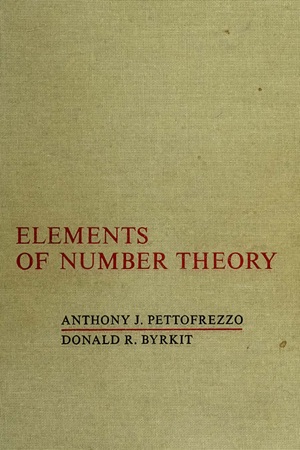
Elements of Number Theory
38.10 $
| Author(s) |
Anthony J. Pettofrezzo ,Donald R. Byrkit |
|---|---|
| Product Type |
Ebook |
| Format |
|
| Skill Level |
Intermediate to Advanced |
| Pages |
264 |
| Publication Year |
1970 |
| Delivery |
Instant Download |
This edition of Elements of Number Theory by Anthony J. Pettofrezzo and Donald R. Byrkit is a rigorous yet carefully structured introduction to the arithmetic of the integers. The authors develop number theory from first principles, beginning with ordered integral domains and mathematical induction, then moving step by step into divisibility, primes, congruences, and continued fractions.
Although written as a university-level mathematics text, it is also highly valuable for readers of esoteric and numerological traditions who want a solid, technical foundation in the behavior of whole numbers. Concepts such as prime decomposition, divisor functions, Euler’s φ-function, congruences, and continued fractions provide the exact arithmetic framework behind “sacred number” patterns, modular cycles, and many traditional numerical schemes.
Throughout the book, definitions, theorems, proofs, and worked examples are presented in a clean, logical order. Exercises (with selected answers) allow the reader to test understanding and gradually build fluency in formal number-theoretic reasoning. For LostLibrary, this volume serves as a bridge between pure mathematics and the deeper exploration of Numerology & Sacred Numbers, giving you the tools to distinguish genuine numerical structure from mere coincidence.
✅ What You’ll Learn:
- How the system of integers is structured as an ordered integral domain and how mathematical induction works as a proof technique.
- The full machinery of divisibility: primes and composites, greatest common divisors (including generalized GCD), and the Fundamental Theorem of Arithmetic.
- How to work with divisor functions, including the sum and number of divisors, perfect numbers, and Mersenne numbers.
- The definition and properties of Euler’s φ-function and how to solve equations involving φ(n).
- The theory of congruences: basic properties, important congruence theorems, reduced residue systems, and the theorems of Euler and Fermat.
- Techniques for solving linear congruences, their connection to linear Diophantine equations, and key results like Wilson’s Theorem and the Chinese Remainder Theorem.
- The basics of quadratic congruences and how they arise in deeper number-theoretic problems.
- A complete introduction to finite and infinite continued fractions, convergents, approximation theorems, and their use in solving quadratic equations and Diophantine problems.
💡 Key Benefits:
- Gain a solid, formal grounding in elementary number theory that supports both academic study and serious explorations of numerical symbolism.
- Learn to prove statements rigorously using induction, divisibility properties, and congruence arguments, improving your logical and analytical skills.
- Understand the structure behind primes, divisors, and modular arithmetic, which underlies many traditional “sacred number” systems and cyclical patterns.
- Use continued fractions and approximation theorems to see how rational and irrational quantities can be represented and studied with precision.
- Benefit from carefully graded exercises and selected answers that reinforce understanding and encourage independent problem solving.
- Build a toolkit that can be applied in cryptography, coding theory, mathematical research, and advanced esoteric numerology.
👤 Who This Book Is For:
- Readers on LostLibrary who are serious about Numerology & Sacred Numbers and want to move beyond popular treatments into the exact arithmetic structure behind those ideas.
- Students of mathematics at the upper high-school, undergraduate, or self-study level who have a good command of algebra and want a focused introduction to number theory.
- Practitioners of occult, Kabbalistic, or esoteric systems who wish to cross-check traditional number correspondences against formal number-theoretic properties.
- Researchers, coders, and analytically minded readers who need a clean, theorem–proof style text on integers, congruences, and continued fractions.
- Anyone interested in seeing how simple whole numbers give rise to deep structures, patterns, and constraints that echo through both mathematics and metaphysical systems.
📚 Table of Contents:
Chapter 1 – Preliminary Considerations
- 1.1 Ordered Integral Domains
- 1.2 Mathematical Induction
- 1.3 Number Bases
- 1.4 Notations for Sums and Products
Chapter 2 – Divisibility Properties of Integers
- 2.1 Prime and Composite Numbers
- 2.2 Some Properties of Prime Numbers
- 2.3 The Greatest Common Divisor
- 2.4 The Generalized Greatest Common Divisor
- 2.5 Properties of the Greatest Common Divisor
- 2.6 Linear Diophantine Equations
- 2.7 The Fundamental Theorem of Arithmetic
- 2.8 Sum of Divisors
- 2.9 Number of Divisors
- 2.10 Perfect Numbers
- 2.11 Mersenne Numbers
- 2.12 The Euler φ-Function
- 2.13 Properties of the Euler φ-Function
- 2.14 Solution of the Equation φ(x) = m
Chapter 3 – The Theory of Congruences
- 3.1 Definitions and Elementary Properties
- 3.2 Some Congruence Theorems
- 3.3 An Application of the Congruence Relation
- 3.4 Reduced Residue Systems Modulo m
- 3.5 The Theorems of Euler and Fermat
- 3.6 Linear Congruences
- 3.7 Linear Congruences and Linear Diophantine Equations
- 3.8 Wilson’s Theorem
- 3.9 Linear Congruences in Two Variables
- 3.10 The Chinese Remainder Theorem
- 3.11 Quadratic Congruences
Chapter 4 – Continued Fractions
- 4.1 Finite Continued Fractions
- 4.2 Infinite Continued Fractions
- 4.3 Convergents
- 4.4 Evaluation of Convergents
- 4.5 Convergents as Determinants
- 4.6 Some Properties of Convergents
- 4.7 Continued Fractions and Linear Diophantine Equations
- 4.8 Theorems on Infinite Continued Fractions
- 4.9 Approximation Theorems
- 4.10 Use of Continued Fractions in Solving Quadratic Equations
- 4.11 Periodic Continued Fractions
- 4.12 Continued Fractions for Qₖ
Elements of Number Theory By Anthony J. Pettofrezzo, Donald R. Byrkit