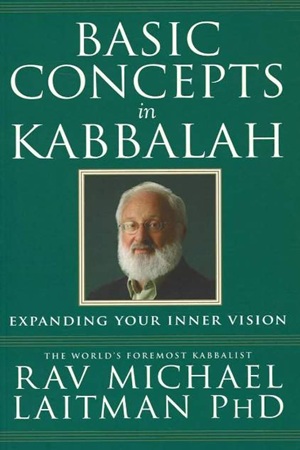
Basic Concepts in Kabbalah
11.40 $
| Author(s) |
Rav Michael Laitman |
|---|---|
| Product Type |
Ebook |
| Format |
|
| Skill Level |
Beginner to Intermediate |
| Pages |
112 |
| Publication Year |
2006 |
| Delivery |
Instant Download |
Basic Concepts in Kabbalah is designed as an orientation manual: it does not try to overwhelm the reader with mystical storytelling or symbolic overload, but instead builds a disciplined vocabulary for approaching Kabbalah as a method of perception—a structured way to examine reality, consciousness, and the relationship between the created being and the Upper Force. The author explicitly frames the book as something to be read and re-read so the reader develops “internal observations” and a felt grasp of spiritual terms, rather than merely collecting facts.
Rather than focusing on devotional mysticism, the text repeatedly emphasizes causality, lawfulness, and the idea that creation operates through purposeful laws. The reader is introduced to key foundations that appear throughout classic Kabbalistic study: the concept of desire as the substance of creation, the Light and the vessel, the unfolding through stages into ten Sefirot, and the descent/ascent through the worlds (ABYA and beyond).
A major feature of the book is that it does not remain purely “introductory commentary.” Several chapters are directly drawn from or built around classical introductions tied to The Zohar and The Study of the Ten Sefirot, specifically to protect the student from common misunderstandings—especially the tendency to materialize spiritual concepts. These sections reinforce boundaries of correct perception (what can be studied, what cannot), and why Kabbalah insists on precision when speaking about essence, form, and matter.
For LostLibrary readers, this is best positioned as a clean entry point into Kabbalistic language—grounded, structured, and ideal for those who want a conceptual map before entering heavier works like Zohar study or systematic Sefirot texts.
✅ What You’ll Learn:
- Why Kabbalah is presented as a method of perception/attainment, not a set of beliefs
- The book’s foundational model of Light and vessel (desire) and why desire is treated as “substance”
- The structure of ten Sefirot and their role as graded filters of perception
- The worlds and mapping logic of ABYA / BYA, including what is (and is not) researched in Zohar study
- The “language of Kabbalah” approach (why terms must be handled precisely)
- Core boundaries of study: Matter, Form in Matter, Abstract Form, Essence—and why misreading these leads to confusion
- A practical orientation to how genuine study is meant to reshape inner sensation over time
💡 Key Benefits:
- A structured “first framework” that reduces confusion before a reader enters heavier Kabbalistic texts.
- Strong emphasis on non-materialized interpretation, guarding against common modern distortions.
- Clear conceptual mapping of worlds/Sefirot that supports future study of Zohar and systematic teachings.
- Short, modular chapters plus “Key Concepts” and FAQ make it suitable for incremental reading and revision.
👤 Who This Book Is For:
- Readers who want a disciplined introduction to Kabbalah’s core terms and study boundaries
- Students preparing for more advanced works connected to The Zohar and Ten Sefirot study
- Anyone seeking a metaphysical system focused on perception, inner development, and structured spiritual language (not “instant results” mysticism)
📚 Table of Contents:
- Chapter 1: The Method of Perception in Kabbalah
- Chapter 2: The Purpose of Kabbalah
- Chapter 3: The Giving of Kabbalah
- Chapter 4: Perfection and the World
- Chapter 5: Freedom of Will
- Chapter 6: The Essence and the Purpose of Kabbalah
- Chapter 7: From the Afterword to the Zohar
- Chapter 8: The Language of Kabbalah
- Chapter 9: From the Preface to the Zohar
- Chapter 10: From the Introduction to the Zohar
- Chapter 11: From the Introduction to the Study of the Ten Sefirot
- Chapter 12: Conditions for Disclosing the Secrets of the Wisdom of Kabbalah
- Chapter 13: Key Concepts
- Chapter 14: Frequently Asked Questions
- Further Reading
- About Bnei Baruch
- How to Contact Bnei Baruch
Basic Concepts in Kabbalah By Rav Michael Laitman